


Why Has Smart Energy Management Become an Operational Necessity?
Rising energy costs, increasing pressure on electrical infrastructure, the growing number of electrical devices in buildings, and greater reliance on cooling, heating, and lighting systems have made energy consumption one of the major challenges in construction and building operations. In many facilities, energy consumption is still managed manually, in a fragmented manner, and without analytical visibility.
Under these conditions, the following problems are commonly observed:
-
Equipment remaining on when not actually needed
-
Lack of centralized control
-
Hidden energy consumption during non-working hours
-
Complete dependence on user behavior
-
Lack of actionable data
-
Increased operating costs
What Exactly Does Smart Energy Management Do?
Smart energy management means transforming energy consumption from an opaque and reactive process into a system that can be monitored, controlled, and optimized.
With this approach:
-
Energy consumption can be monitored and measured separately for each area
-
Equipment can be controlled through predefined scenarios
-
Unnecessary operation is eliminated
-
High-consumption loads can be managed
-
Control is shifted from manual operation to automated and intelligent management
Instead of simply seeing your energy bill, you can see consumption patterns and take action to optimize them.
Key Components of a Smart Energy Management Solution
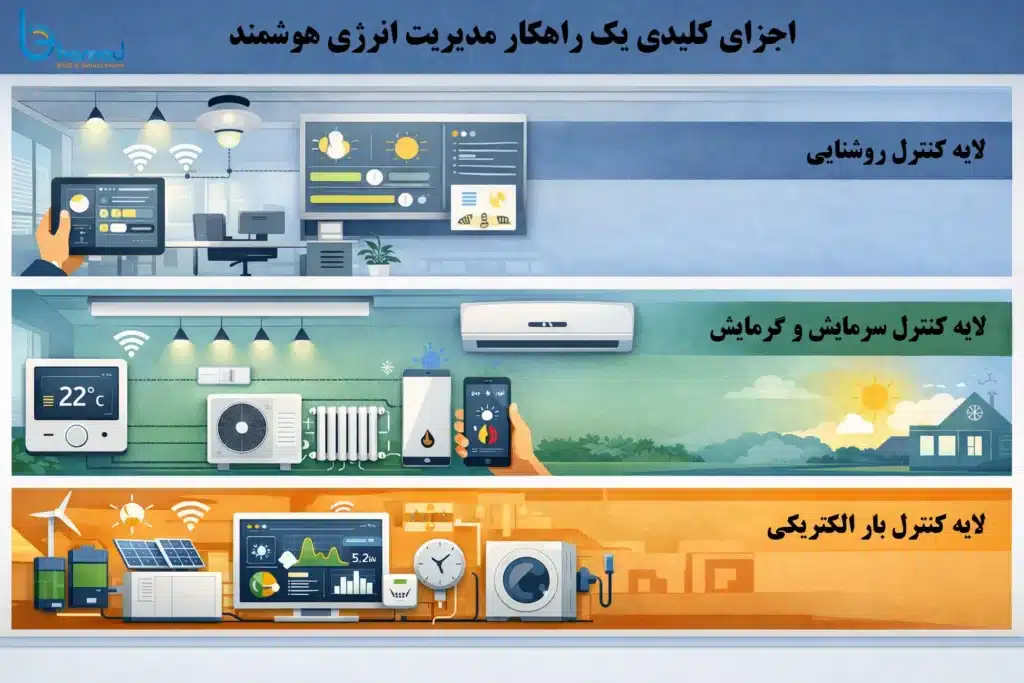
An effective energy management solution typically consists of several control layers. These layers focus on controlling energy consumption at the point of use.
Lighting Control Layer
-
Scheduling lighting to turn on and off
-
Exit and absence scenarios
-
Adjusting light intensity
-
Group control of spaces
-
Eliminating unnecessary continuous lighting
Lighting is one of the fastest areas where measurable energy savings can be achieved.
Cooling and Heating Control Layer
-
Adjusting temperature based on occupancy
-
Scheduling operating hours
-
Automatically changing consumption modes during non-working hours
-
Preventing conflicting systems from operating simultaneously
Smart HVAC control typically plays a significant role in reducing energy costs.
Electrical Load Control Layer
-
Disconnecting unnecessary loads
-
Prioritizing energy consumption
-
Managing high-consumption circuits
-
Limiting consumption during peak hours
-
Automatically turning off selected equipment
At this layer, consumption shifts from being “always on” to being “based on actual demand.”
Remote-Controlled Equipment Layer
Many devices, such as independent cooling systems, audio and video equipment, or certain controllers, operate via remote controls and typically remain outside centralized management. In a smart solution, these devices are also incorporated into energy management scenarios and can be turned off or limited under predefined conditions.
Environmental and Auxiliary Conditions Control Layer
-
Better utilization of natural light
-
Control of motorized equipment associated with the building envelope
-
Management of certain fluid flows to improve safety and efficiency
This layer contributes to indirect energy optimization.
Practical Energy Management Scenarios for Projects
An energy management solution becomes valuable when it is translated into practical operating scenarios. Here are some common examples:
Exit Scenario
When exit mode is activated:
-
Lights are turned off
-
Selected circuits are disconnected
-
Unnecessary equipment is deactivated
-
The climate control system switches to energy-saving mode
This scenario alone can eliminate a significant portion of hidden energy consumption.
Non-Working Hours Scenario
In office and commercial buildings:
-
Only essential circuits remain active
-
Climate control systems are limited
-
Common-area lighting switches to low-consumption mode
Night Scenario
-
Reducing lighting levels
-
Setting an optimal nighttime temperature
-
Turning off secondary equipment
-
Activating minimum-control settings
Occupancy Scenario
When occupancy is detected or working hours begin:
-
Only occupied spaces are illuminated
-
Required equipment is activated
-
Unnecessary consumption is eliminated
Measurable Benefits of Smart Energy Management
A proper solution should deliver measurable results. Experience from implemented projects shows that the following benefits can be achieved:
-
Reduced energy costs (typically 15–35%, depending on the project)
-
Reduced hidden energy consumption
-
Reduced equipment wear and tear
-
Extended lifespan of climate control systems
-
Reduced human error
-
Faster response to emergency conditions
-
Greater visibility into energy consumption
-
Data-driven decision-making
-
Increased technical value of the project
The focus of this solution is operational results, not simply showcasing technology.
Is This Solution Only Suitable for New Projects?
No. One of the key advantages of modern energy management solutions is that they can be implemented in operational projects. In many existing buildings, smart control layers can be added without extensive renovation.
Implementation in existing projects typically includes:
-
Adding control equipment at points of consumption
-
Upgrading key control points
-
Adding centralized control
-
Defining energy consumption scenarios
This means the system can be implemented gradually and in a controlled manner.
Our Implementation Approach
Smart energy management is not a single product — it is a project-based solution. Effective implementation requires proper design and scenario planning.
The implementation process includes:
- Initial assessment of consumption patterns
- Identifying controllable points
- Defining consumption reduction scenarios
- Designing control layers
- Selecting suitable equipment
- Procurement and implementation
- Activating and configuring scenarios
- Training the operator
- Enabling phased expansion
This approach ensures that the system is practical, usable, and sustainable.

Which Organizations Benefit the Most?
This solution is not limited to a specific type of facility and can be implemented at different scales:
-
Multi-unit residential buildings
-
Towers and residential complexes
-
Office buildings
-
Commercial spaces
-
Hotels and hospitality facilities
-
Renovation projects
-
Organizational facilities
-
Light industrial facilities
The solution is tailored to the scale and requirements of each project.
Conclusion
Smart energy management is an operational approach for transforming fragmented and uncontrolled energy consumption into a manageable system. By designing scenarios, creating control layers, and using smart building technologies, energy consumption can be targeted, monitored, and optimized.
This solution can be implemented in both new and existing projects and can be expanded according to the specific needs of each facility.
If you are looking to practically manage and optimize energy consumption in your project or building, you can contact us for an initial assessment and an implementation proposal tailored to your requirements, or visit our Products Page.
✔️ Submit a consultation request
✔️ Receive an implementation proposal
✔️ Inquire about equipment and scenario design
Frequently Asked Questions
Is implementing smart energy management complicated?
No, not when it is properly designed. The system is implemented around practical scenarios and is easy for operators to use.
Can the project be implemented in phases?
Yes. Many projects are implemented in phases.
Do only large buildings need this solution?
No. Even medium-sized projects can achieve significant energy savings.
Is remote control possible?
Yes. In most implementations, control is available through a mobile app or management panel.
Can a return on investment be expected?
Yes. Depending on the type of consumption, the return on investment typically occurs within a reasonable operational timeframe.