


Common Challenges in Traditional Hotel Management
Many hotels, including newly built properties, face a recurring set of challenges:
High energy consumption in unoccupied rooms
Heating, cooling, and lighting systems remaining on when guests are not present
Lack of real-time visibility into equipment status
High staffing costs for monitoring and responding to issues
Poor coordination between reception, housekeeping, and facility management
Guest dissatisfaction caused by difficult-to-use in-room controls
Delays in detecting equipment failures
A hotel automation solution is designed specifically to address these challenges, not simply to make the building look more modern.
What Exactly Does Hotel Automation Do?
In a smart hotel, key equipment is connected to a central control platform, and its operation is adjusted based on guest presence, predefined scenarios, and real-time data.
Examples of practical capabilities:
Integrated control of lighting, HVAC, and curtains
Room status management (occupied / vacant / being cleaned)
Automatic shutdown of high-consumption devices when the room is unoccupied
Guest access to room controls through a panel or mobile device
Centralized control and monitoring for hotel management
Energy consumption logging and reporting
Automatic equipment fault and failure alerts
Room access and movement management
This system can be implemented in both new projects and operating hotels without extensive structural modifications.
Which Areas of a Hotel Can Be Automated?
Hotel automation is not limited to guest rooms and can cover the entire property:
Rooms and Suites
Guest arrival and departure scenarios
Lighting and temperature control
Motorized curtains and blinds
Occupancy management
Equipment control through a panel or mobile device
Common Areas
Lobbies and corridors
Breakfast areas and restaurants
Conference halls
Parking areas
Facilities and Energy
Smart control of heating and cooling systems
Consumption management during peak hours
Scheduling of high-consumption equipment
Real-time consumption monitoring
Security and Safety
Smart locks
Personnel access control
Fire and gas leak alerts
Automatic power and gas shutoff in hazardous situations
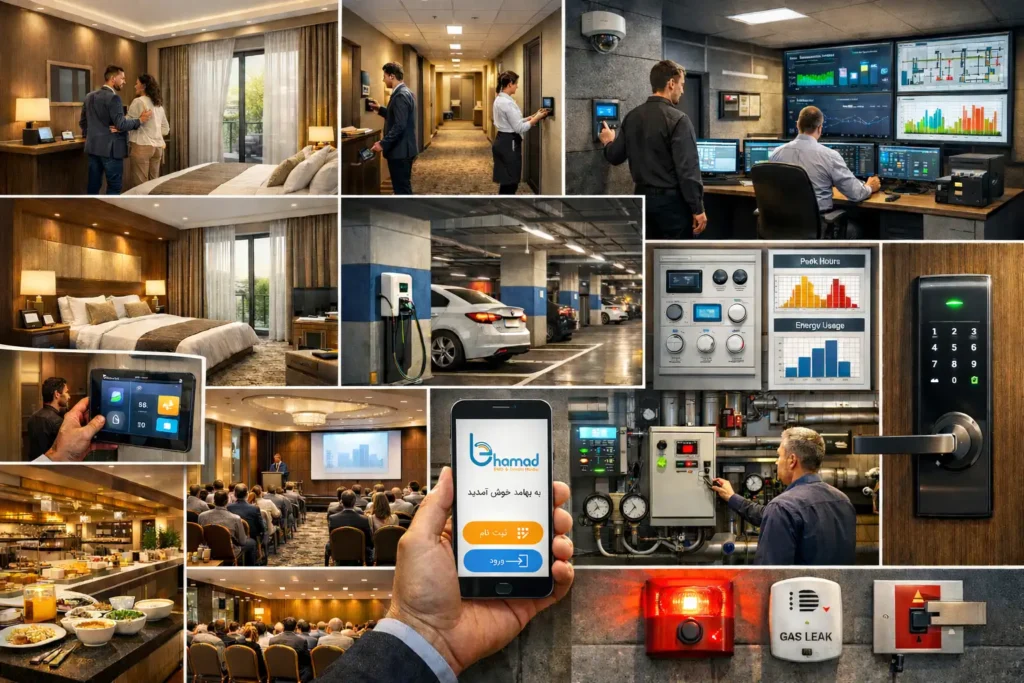
Practical Scenarios in a Smart Hotel
One of the main differences between smart automation and simple automation is the ability to define operational scenarios.
For example:
Guest Room Arrival Scenario:
Soft lighting is activated when the door is opened
The room temperature is set to the predefined level
The curtains are adjusted
The system switches to guest occupancy mode
Guest Departure Scenario:
All lights are turned off
HVAC switches to energy-saving mode
Non-essential equipment is switched off
Room status is recorded for housekeeping
Vacant Room Scenario:
Reduced energy consumption
Safety monitoring mode is activated
Preparation for the next guest arrival
Measurable Benefits of Hotel Automation
Real Energy Cost Reduction
By managing occupancy and energy consumption, energy consumption in guest rooms can typically be reduced by 20% to 40%, especially in hotels with variable occupancy rates.
Increased Guest Satisfaction
Today’s guests expect simple and fast control. A customizable room experience improves guest satisfaction and online ratings.
Increased Staff Productivity
Many repetitive guest requests can be handled automatically by the system, reducing the workload of reception and service staff.
Reduced Failures and Maintenance Costs
Sensors and system reports can detect early signs of equipment failure, helping prevent costly repairs.
Increased Competitive Appeal
In the online booking market, smart amenities are considered a genuine competitive advantage, not merely a decorative feature.
Can Older Hotels Also Be Automated?
Yes. A common misconception is that only newly built properties can be automated. In practice, many hotel automation solutions can be implemented in a modular and minimally invasive manner:
Using wireless equipment
Gradually replacing switches and thermostats
Adding centralized control without major wiring modifications
Phased implementation by floor
This allows the project to proceed without interrupting hotel operations.
Centralized Management; Complete Visibility for Hotel Managers
One of the most valuable components of a hotel automation solution is the management dashboard. Hotel management can:
View the status of all rooms in real time
Analyze energy consumption
Receive technical alerts
Modify scenarios
Manage access permissions
Generate periodic reports
This level of operational transparency is virtually unavailable in traditional hotels.
Conclusion
Hotel automation is not a luxury expense; it is a management tool for controlling costs, enhancing the guest experience, and optimizing operations. When properly designed and implemented in phases, it can be deployed in both new projects and operating hotels, with measurable benefits in energy consumption, service quality, and customer satisfaction.